Request Military Records and Your DD-214
Get a copy of your DD-214 or your full military service file. Answer a few questions in ChatGPT or Claude and get the official SF-180, filled in and ready to sign.
- For
- Veterans, next of kin of deceased veterans, and their legal guardians or authorized representatives
- Time
- About 5 minutes
- Price
- $4.90, one-time · Government fees not included
You review the filled PDF before you pay. Then you sign it and file it yourself.
4.8 · 275 reviews for this formUpdated November 28, 2026 · Latest edition
 Official PDF · latest edition
What you'll need
- 1The veteran’s complete name used during service
- 2Service number and/or Social Security number, and date and place of birth
- 3Branch, dates of service and last duty station
- 4Proof of death, if you are the next of kin of a deceased veteran
- 5Your handwritten signature (not needed for archival records)
The guide
Form SF-180, explained
Key points
- Ask for the DD-214, the full personnel file (OMPF), or medical or dental records.
- An undeleted DD-214, the version needed for most benefits, is sent unless you ask for a deleted copy.
- Next of kin must include proof of death, such as a death certificate or an obituary.
- Where it goes depends on the branch and discharge date. The form’s address table lists each office.
What is Form SF-180?
Standard Form 180 (SF-180) is the form veterans, next of kin and others use to request military records, including a copy of the DD-214. You mail or fax it to the records office listed on the form for the veteran’s branch and discharge date.
Its official name is “Request Pertaining to Military Records”. You mail or fax it to the records office listed on the form. The same request can also be made online with eVetRecs.
Who files it
Veterans, next of kin of deceased veterans, and their legal guardians or authorized representatives.
What you need before you start
- The veteran’s complete name used during service
- Service number and/or Social Security number, and date and place of birth
- Branch, dates of service and last duty station
- Proof of death, if you are the next of kin of a deceased veteran
- Your handwritten signature (not needed for archival records)
Skip the instructions.
Answer a few questions in ChatGPT or Claude. We fill every box of your SF-180.
How to fill out Form SF-180, section by section
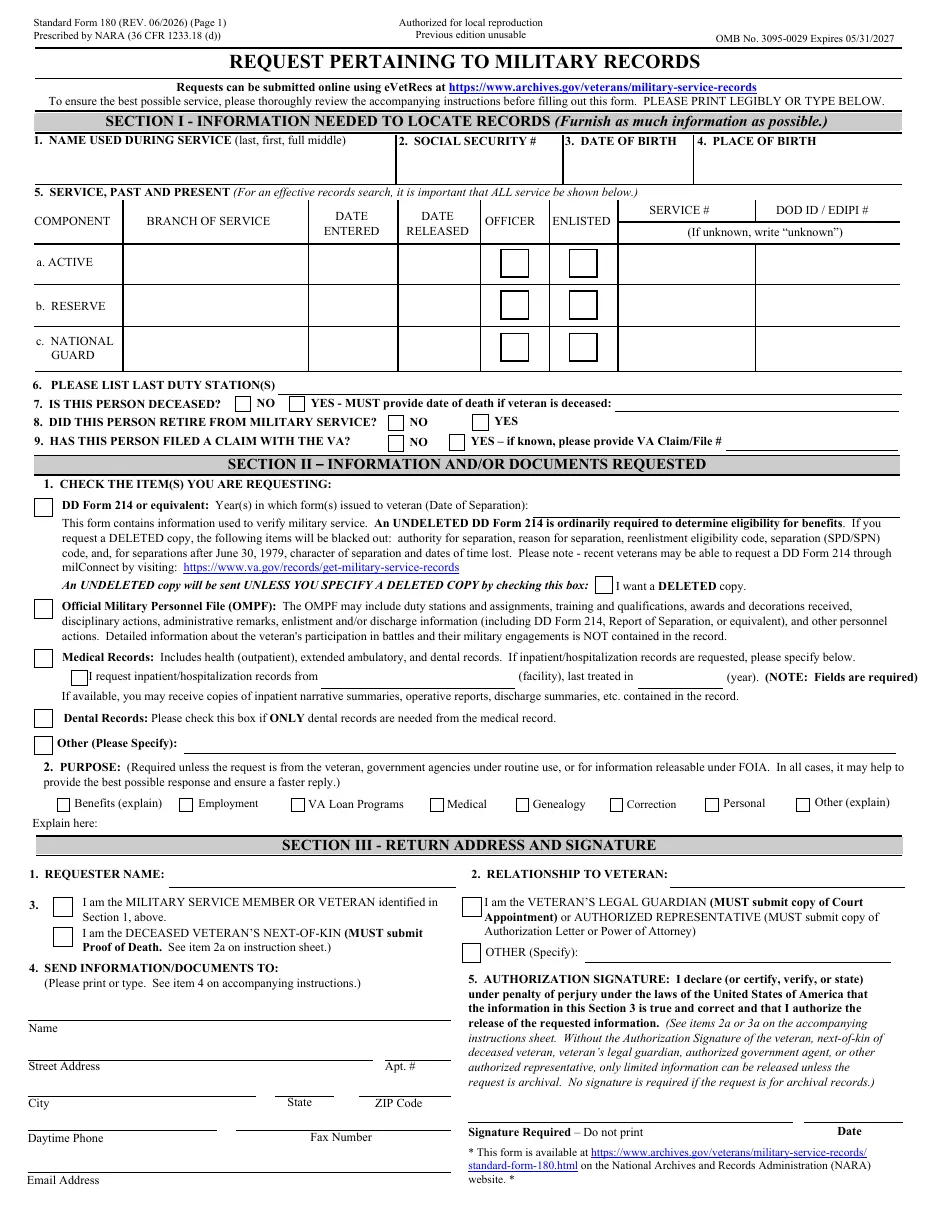
- Section I, items 1-4Who the veteran isName used during service, Social Security number, date of birth and place of birth.
- Section I, item 5Service, past and presentList all active, reserve and National Guard service: branch, dates entered and released, officer or enlisted, and service number or DoD ID if known.
- Section I, items 6-9StatusLast duty station, whether the veteran is deceased (with the date of death), retired, or has filed a VA claim.
- Section II, item 1What you are requestingCheck DD Form 214, the full personnel file, medical or dental records, or other. An undeleted DD-214 is sent unless you check the box for a deleted copy.
- Section II, item 2PurposeCheck benefits, employment, VA loan, medical, genealogy or another reason. It is required unless you are the veteran, and it can speed up the reply.
- Section III, items 1-4Requester and return addressYour name, your relationship to the veteran, whether you are the veteran, next of kin, guardian or representative, and where to send the records.
- Section III, item 5Authorization signatureSign by hand and date. Without the right signature, only limited information can be released unless the records are archival.
Government fee
Free for most requests from veterans and next of kin. Archival records, for service that ended 62 or more years ago, carry copy fees, such as a $70 flat fee for a routine personnel file of 6 pages or more. Source: National Archives military service records page and SF 180 instructions (Rev. 06/2026).
The $4.90 forms. fee is separate. Government fees are always paid directly to the agency.
Where Form SF-180 goes
Mail or fax it to the records office in the form’s address table for the veteran’s branch and discharge date. Many requests go to the National Personnel Records Center in St. Louis. Email is not accepted.
Common mistakes to avoid
- Leaving out the service number, branch or dates. Missing details can delay the search.
- Forgetting proof of death when you request a deceased veteran’s records as next of kin.
- Printing your name in the signature box instead of signing it.
- Sending it to the wrong office. Check the form’s address table for the branch and discharge date.
- Sending a follow-up request before 90 days have passed, which can cause further delays.
When the free official option is enough
You can request records online for free with eVetRecs on archives.gov after verifying your identity with ID.me, and recent veterans may be able to request a DD-214 through milConnect. forms. is for when you'd rather answer questions in plain English and get a checked PDF.
Questions
- How do I get a copy of my DD-214?
- Request it online with eVetRecs on archives.gov, through milConnect if you are a recent veteran, or with Standard Form 180 by mail or fax. Most veterans and next of kin get it free.
- How much does it cost to request military records?
- Generally nothing for basic personnel and medical record information requested by veterans and next of kin. Archival records, for service that ended 62 or more years ago, are open to the public but carry copy fees.
- Who can request a veteran’s military records?
- The veteran, the next of kin of a deceased veteran (with proof of death), a legal guardian or an authorized representative. Others can get only limited information, unless the records are archival.
- Can I fax the SF-180?
- Yes. The National Archives accepts the SF-180 by mail or fax, but not by email. Use a separate SF-180 for each veteran.
- How long does an SF-180 request take?
- It varies. The National Archives asks you not to send a follow-up request before 90 days, and says express mail doesn’t make it faster.
- Is this the official form?
- Yes. We fill the Form SF-180 published by the National Archives, in its latest edition. You sign it and file it yourself.
- What does the $4.90 cover?
- Filling in the form and downloading the PDF. Government fees, if any, are paid separately to the agency.