Foreign Entity Tax Status Certificate
Certify your company’s foreign status to a U.S. payer. Answer a few questions in ChatGPT or Claude and get the official W-8BEN-E, filled in and ready to sign.
- For
- Foreign companies and other foreign entities paid by a U.S. client, platform, bank or broker
- Time
- About 20 minutes
- Price
- $4.90, one-time · Government fees not included
You review the filled PDF before you pay. Then you sign it and file it yourself.
4.8 · 395 reviews for this formUpdated November 28, 2026 · Latest edition
 Official PDF · latest edition
What you'll need
- 1The entity’s legal name and country of incorporation or organization
- 2Its entity type under U.S. tax rules (chapter 3 status)
- 3Its FATCA status (chapter 4 status), such as active NFFE
- 4Its permanent address, its foreign tax ID and, if required, a U.S. EIN
- 5The treaty article and rate, if you claim treaty benefits
The guide
Form W-8BEN-E, explained
Key points
- For foreign entities only. Foreign individuals use Form W-8BEN; U.S. companies use Form W-9.
- Give it to the payer before you are paid. Without it, the payer may have to withhold 30%.
- Most chapter 4 statuses require you to complete a matching certification part of the form.
- It is generally valid until the end of the third calendar year after you sign it, unless your facts change.
What is Form W-8BEN-E?
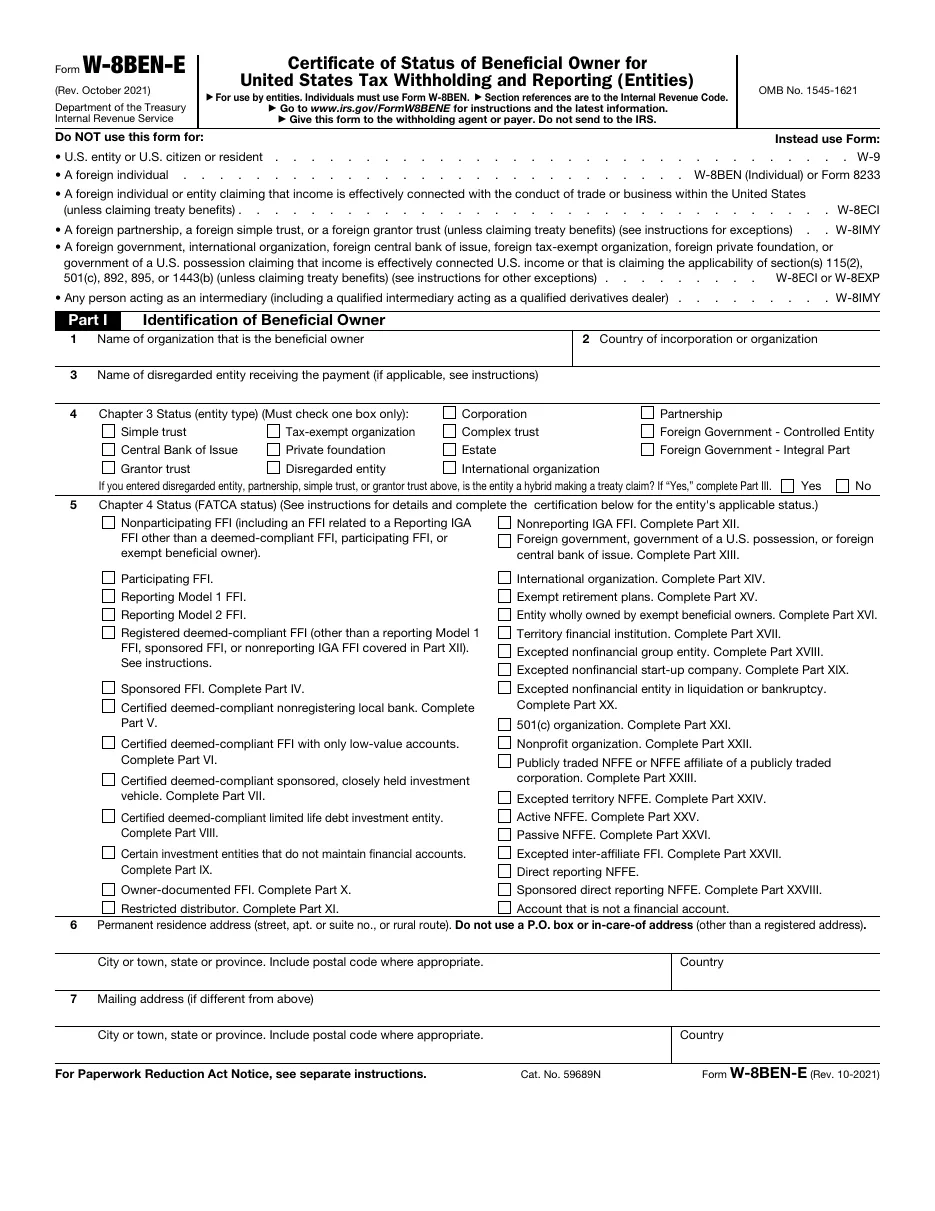
Form W-8BEN-E is the IRS form a foreign company or other foreign entity gives to a U.S. payer to certify its foreign status, its FATCA status and any tax treaty benefits. It goes to the withholding agent or payer that asked for it, not to the IRS.
Its official name is “Certificate of Status of Beneficial Owner for United States Tax Withholding and Reporting (Entities)”. You give it to the withholding agent or payer before you are paid. It is not filed with the IRS.
Who files it
Foreign companies and other foreign entities paid by a U.S. client, platform, bank or broker.
What you need before you start
- The entity’s legal name and country of incorporation or organization
- Its entity type under U.S. tax rules (chapter 3 status)
- Its FATCA status (chapter 4 status), such as active NFFE
- Its permanent address, its foreign tax ID and, if required, a U.S. EIN
- The treaty article and rate, if you claim treaty benefits
Skip the instructions.
Answer a few questions in ChatGPT or Claude. We fill every box of your W-8BEN-E.
How to fill out Form W-8BEN-E, section by section
- Lines 1-3Identification of beneficial ownerEnter the entity’s legal name and country of incorporation. A disregarded entity enters its owner’s legal name on line 1, not its own.
- Line 4Chapter 3 statusCheck one entity type, such as corporation or partnership, based on how the entity is classified under U.S. tax rules, not local law.
- Line 5Chapter 4 (FATCA) statusCheck the one status that applies, such as active NFFE, and note which part of the form you must then complete.
- Lines 6-10Addresses and tax numbersPermanent residence address (no P.O. box), mailing address if different, a U.S. EIN if required, your GIIN or foreign tax ID, and any reference number.
- Part IIITax treaty benefitsOnly if you claim a reduced rate: your treaty country on line 14a, the limitation on benefits test on 14b, and any special rate on line 15.
- Parts IV-XXIXStatus certificationComplete only the part that matches the status you checked on line 5, for example Part XXV for an active NFFE.
- Part XXXCertificationAn authorized officer or representative signs, prints their name, dates the form and checks the box confirming they can sign for the entity.
Government fee
Free: the IRS charges no fee to file this form.
The $4.90 forms. fee is separate. Government fees are always paid directly to the agency.
Where Form W-8BEN-E goes
Give it to the withholding agent or payer that asked for it, such as a U.S. client, marketplace, bank or broker. Do not send it to the IRS.
Common mistakes to avoid
- Filling it out for a person. Individuals use Form W-8BEN.
- Entering a disregarded entity’s own name on line 1 instead of its owner’s.
- Checking a FATCA status on line 5 without completing the matching certification part.
- Using a P.O. box or in-care-of address as the permanent residence address on line 6.
- Claiming treaty benefits with neither a foreign tax ID on line 9b nor a U.S. EIN on line 8.
When the free official option is enough
The IRS publishes a fillable PDF of this form for free on irs.gov. forms. is for when you'd rather answer questions in plain English and get a checked PDF.
Questions
- Who needs to fill out a W-8BEN-E?
- A foreign entity that receives certain U.S. payments, or that holds an account with a financial institution that asks for it. Foreign individuals use Form W-8BEN, and U.S. entities use Form W-9.
- What happens if I don’t submit a W-8BEN-E?
- The payer may have to withhold tax at 30%, or at the backup withholding rate, from payments to you.
- How long is a W-8BEN-E valid?
- Generally from the date you sign it until the last day of the third calendar year after that, so a form signed in 2026 usually stays valid through December 31, 2029. If something on it becomes incorrect, give the payer a new form within 30 days.
- What is an active NFFE on Form W-8BEN-E?
- A foreign entity that is not a financial institution, with less than 50% passive income in the prior year and less than 50% of its assets producing passive income. It checks "Active NFFE" on line 5 and completes Part XXV. If you are unsure of your status, ask a tax professional.
- Do I need a U.S. EIN for a W-8BEN-E?
- Not always. You must give a U.S. taxpayer ID on line 8 in some cases, for example when you claim treaty benefits without a foreign tax ID on line 9b. The IRS instructions list the other cases.
- Is this the official form?
- Yes. We fill the Form W-8BEN-E published by the Internal Revenue Service, in its latest edition. You sign it and file it yourself.
- What does the $4.90 cover?
- Filling in the form and downloading the PDF. Government fees, if any, are paid separately to the agency.