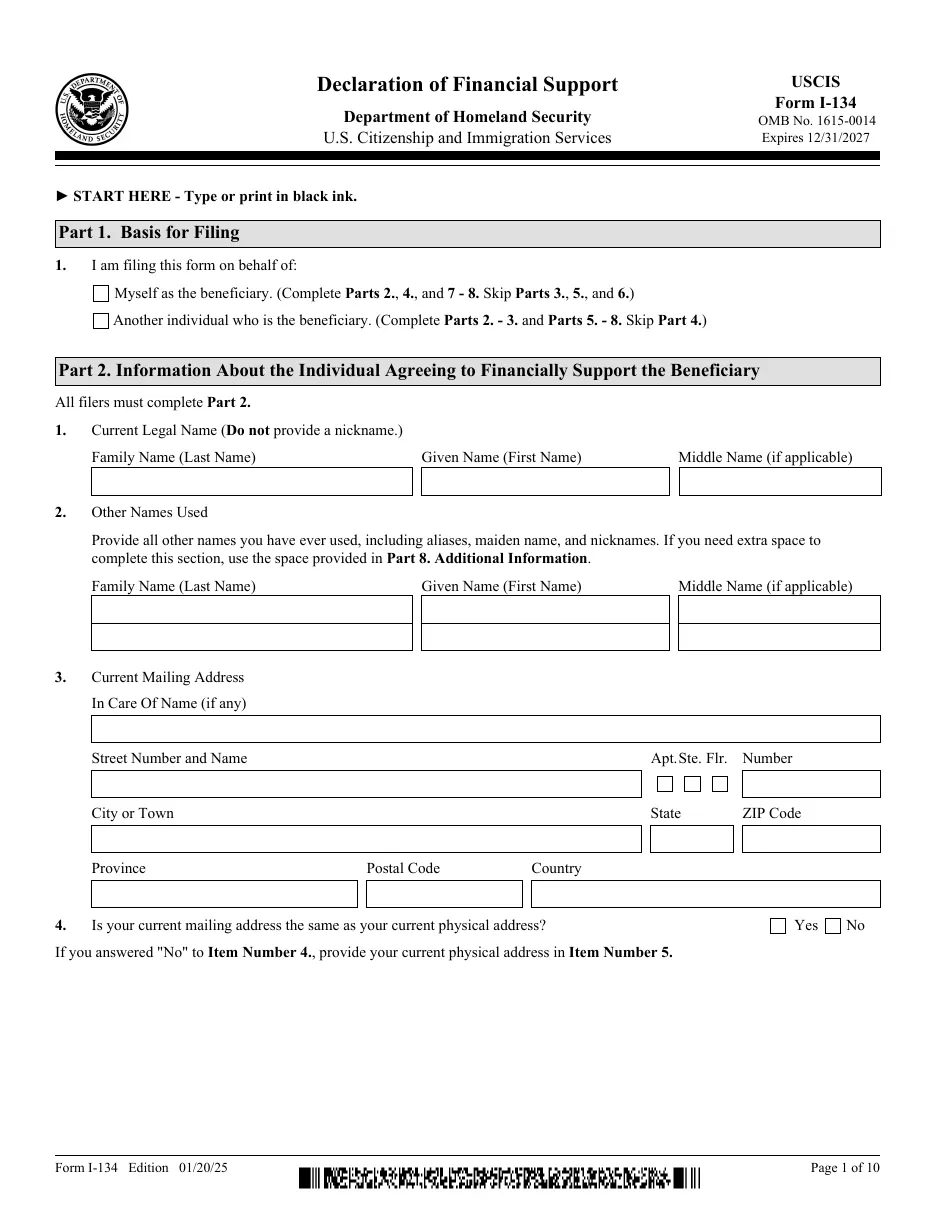
Declaration of Financial Support
Show you can support a visitor or parolee during their stay. Answer a few questions in ChatGPT or Claude and get the official I-134, filled in and ready to sign.
- For
- Supporters of parole applicants or of B, F and M nonimmigrants, or applicants supporting themselves
- Time
- About 15 minutes
- Price
- $4.90, one-time · Government fees not included
You review the filled PDF before you pay. Then you sign it and file it yourself.
4.8 · 274 reviews for this formUpdated November 28, 2026 · Latest edition
 Official PDF · latest edition
What you'll need
- 1The beneficiary’s full name, birth details and address
- 2Your job, annual income and assets
- 3A bank letter showing when the account opened, deposits and balance
- 4An employer letter, or your latest federal tax return or transcript
- 5Details of the other people you support
The guide
Form I-134, explained
Key points
- It covers a temporary stay, not a green card.
- You file one Form I-134 per beneficiary and sign it with your full name.
- No notary is needed, and USCIS charges no fee.
- Attach proof of income or assets, such as a bank letter and your latest tax return.
What is Form I-134?
Form I-134 is a declaration in which a supporter shows they have the income or assets to support someone during a temporary stay in the United States. It is filed with certain parole requests on Form I-131 or with a B, F or M extension or change of status, and the State Department may also ask for it in certain cases.
Its official name is “Declaration of Financial Support”. It is submitted with the application or case it supports, following that case’s instructions.
Who files it
Supporters of parole applicants or of B, F and M nonimmigrants, or applicants supporting themselves.
What you need before you start
- The beneficiary’s full name, birth details and address
- Your job, annual income and assets
- A bank letter showing when the account opened, deposits and balance
- An employer letter, or your latest federal tax return or transcript
- Details of the other people you support
Skip the instructions.
Answer a few questions in ChatGPT or Claude. We fill every box of your I-134.
How to fill out Form I-134, section by section
- Part 1Basis for FilingSay whether you file for yourself as the beneficiary or for another person. The form tells you which parts to skip.
- Part 2Information About You as the SupporterYour name, addresses, date and place of birth, status, relationship to the beneficiary, job, dependents, income, assets and any specific contributions you will make.
- Part 3Information about the BeneficiaryOnly if you support another person: their names, birth details and address.
- Part 4Beneficiary’s Statement and SignatureOnly if you are the beneficiary supporting yourself.
- Part 5Supporter’s Statement and SignatureSign with your full name. USCIS does not accept a typed name in place of a signature.
- Part 8Additional InformationExtra dependents, assets or explanations.
Government fee
Free: USCIS charges no fee for Form I-134. Source: USCIS Fee Schedule (Form G-1055, edition 11/19/26), checked November 28, 2026.
The $4.90 forms. fee is separate. Government fees are always paid directly to the agency.
Where Form I-134 goes
With the application it supports. Where that is depends on the case and on whether the beneficiary is inside or outside the U.S., so follow that application’s instructions.
Common mistakes to avoid
- Using Form I-134 when the case requires Form I-864, such as most family-based green cards.
- Sending one I-134 for several people. Each beneficiary needs their own.
- Leaving out proof of income or assets. USCIS says this can lead to a denial.
- Counting the beneficiary’s own cash or assets in Part 2, Item 17.
- Forgetting to sign. USCIS rejects unsigned declarations.
When the free official option is enough
USCIS publishes Form I-134 as a free fillable PDF on uscis.gov. forms. is for when you'd rather answer questions in plain English and get a checked PDF.
Questions
- What is Form I-134 used for?
- It shows that the beneficiary will have financial support during a temporary stay. USCIS requires it with certain parole requests filed on Form I-131, and you can file it for a B, F or M nonimmigrant asking to extend or change status. The State Department may also request it in certain cases.
- What is the difference between Form I-134 and Form I-864?
- Form I-134 covers a temporary stay, and the beneficiary does not have to pay you back. Form I-864 is the affidavit of support for most family-based green cards. Do not use Form I-134 when Form I-864 is required.
- Does Form I-134 need to be notarized?
- No. You sign it under penalty of perjury, so USCIS says it does not need a notary.
- Do I need a separate I-134 for each person?
- Yes. You file a separate Form I-134 for each beneficiary you agree to support.
- Where do I send Form I-134?
- It depends on the case and on whether the beneficiary is inside or outside the U.S. Follow the instructions of the application it supports, or the instructions the State Department gives.
- Is this the official form?
- Yes. We fill the Form I-134 published by the U.S. Citizenship and Immigration Services, in its latest edition. You sign it and file it yourself.
- What does the $4.90 cover?
- Filling in the form and downloading the PDF. Government fees, if any, are paid separately to the agency.