Fiancé(e) Visa Petition (K-1)
Start the K-1 visa process to bring your fiancé(e) to the U.S. Answer a few questions in ChatGPT or Claude and get the official I-129F, filled in and ready to sign.
- For
- U.S. citizens bringing a fiancé(e) (K-1), or a spouse with a pending I-130 (K-3), to the U.S.
- Time
- About 45 minutes
- Price
- $4.90, one-time · Government fees not included
You review the filled PDF before you pay. Then you sign it and file it yourself.
4.8 · 396 reviews for this formUpdated November 28, 2026 · Latest edition
 Official PDF · latest edition
What you'll need
- 1Proof of your U.S. citizenship (passport, birth or naturalization certificate)
- 2Proof you met in person within the 2 years before filing
- 3Proof you both intend to marry within 90 days of arrival
- 4Divorce decrees or death certificates for any prior marriages
- 5One passport-style photo of each of you, taken within 30 days
The guide
Form I-129F, explained
Key points
- Only U.S. citizens can file Form I-129F, and it is filed by mail only.
- You must have met in person within the 2 years before filing, unless a waiver applies.
- The USCIS fee is $675, with no fee for a K-3 petition based on a filed I-130.
- After approval, the case moves to the State Department for the K-1 visa interview.
What is Form I-129F?
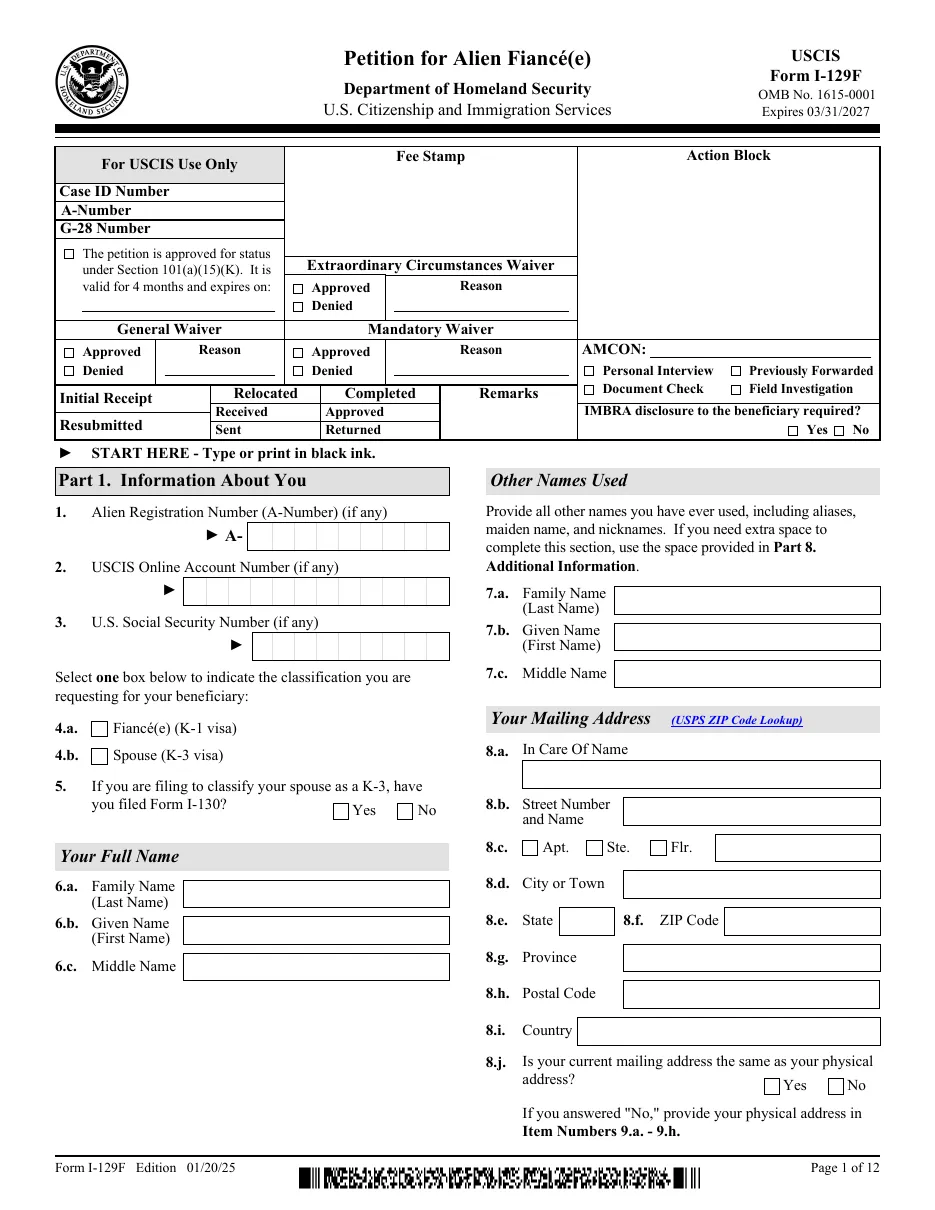
Form I-129F is the petition a U.S. citizen files with USCIS to bring a foreign fiancé(e) to the United States on a K-1 fiancé visa, so you can marry within 90 days of arrival. It is also used for a K-3 spouse visa, and it is filed by mail only.
Its official name is “Petition for Alien Fiancé(e)”. You mail it to USCIS. Online filing is not available for this form.
Who files it
U.S. citizens bringing a fiancé(e) (K-1), or a spouse with a pending I-130 (K-3), to the U.S..
What you need before you start
- Proof of your U.S. citizenship (passport, birth or naturalization certificate)
- Proof you met in person within the 2 years before filing
- Proof you both intend to marry within 90 days of arrival
- Divorce decrees or death certificates for any prior marriages
- One passport-style photo of each of you, taken within 30 days
Skip the instructions.
Answer a few questions in ChatGPT or Claude. We fill every box of your I-129F.
How to fill out Form I-129F, section by section
- Part 1Information About YouChoose K-1 or K-3, then give your names, 5 years of addresses and jobs, your parents, prior marriages, how you hold U.S. citizenship, and any earlier I-129F filings.
- Part 2Information About Your BeneficiaryYour fiancé(e)’s names, birth details, 5 years of addresses and jobs, parents, prior marriages, children, and whether you met in person in the last 2 years.
- Part 3Other InformationQuestions on protection orders and criminal history, plus the multiple filer waiver if you filed for other fiancé(e)s before.
- Part 4Biographic InformationYour ethnicity, race, height, weight, eye color and hair color.
- Part 5Petitioner’s Statement and SignatureSign by hand and date it. USCIS rejects unsigned petitions.
- Part 8Additional InformationExtra addresses, marriages, children or explanations that do not fit elsewhere.
Government fee
$675. There is no fee if you are filing for a K-3 spouse based on a Form I-130 you filed. Source: USCIS Fee Schedule (Form G-1055, edition 11/19/26), checked November 28, 2026.
The $4.90 forms. fee is separate. Government fees are always paid directly to the agency.
Where Form I-129F goes
By mail only, to the USCIS Dallas Lockbox address listed on uscis.gov/i-129f. If you mail it, pay by card with Form G-1450 or by bank debit with Form G-1650.
Common mistakes to avoid
- Leaving out proof of an in-person meeting within the 2 years before filing.
- Missing divorce decrees or death certificates for earlier marriages, yours or your fiancé(e)’s.
- Sending photos older than 30 days, or only one of the two photos.
- Leaving the classification, names or dates of birth blank in Parts 1 and 2. USCIS rejects the petition.
- Not disclosing protection orders or criminal history in Part 3. USCIS shares this information with your fiancé(e) through the State Department.
When the free official option is enough
USCIS publishes Form I-129F as a free PDF on uscis.gov. It cannot be filed online, so every I-129F is mailed on paper. forms. is for when you'd rather answer questions in plain English and get a checked PDF.
Questions
- How do I apply for a fiancé visa?
- The first step is Form I-129F, filed by the U.S. citizen with USCIS. Once USCIS approves it, the petition goes to the State Department’s National Visa Center and then to the embassy or consulate, where your fiancé(e) applies for the K-1 visa.
- What are the requirements for a K-1 fiancé visa?
- You must be a U.S. citizen, you must both be legally free to marry, you must intend to marry within 90 days of your fiancé(e)’s arrival, and you must have met in person within the 2 years before filing, unless you qualify for a waiver.
- How much does Form I-129F cost?
- The USCIS filing fee is $675, according to the USCIS fee schedule. There is no fee for a K-3 petition based on a Form I-130 you filed. The $4.90 forms. fee is separate.
- Can I file Form I-129F online?
- No. Form I-129F is filed by mail to the USCIS lockbox listed on the form’s page.
- What happens if we do not marry within 90 days?
- K-1 status ends after 90 days and cannot be extended, and your fiancé(e) generally must leave the U.S. If you marry later, you file Form I-130 instead.
- Is this the official form?
- Yes. We fill the Form I-129F published by the U.S. Citizenship and Immigration Services, in its latest edition. You sign it and file it yourself.
- What does the $4.90 cover?
- Filling in the form and downloading the PDF. Government fees, if any, are paid separately to the agency.