Parental Consent for a Child’s Passport
Consent to your child’s passport when you can’t be there. Answer a few questions in ChatGPT or Claude and get the official DS-3053, filled in and ready to sign.
- For
- Parents or legal guardians who can’t appear in person with their child to apply for a passport
- Time
- About 5 minutes
- Price
- $4.90, one-time · Government fees not included
You review the filled PDF before you pay. Then you sign it and mail it yourself.
4.8 · 151 reviews for this formUpdated November 28, 2026 · Latest edition
 Official PDF · latest edition
What you'll need
- 1The child’s full name and date of birth, as on the DS-11
- 2The name of the adult applying in person and their relationship to the child
- 3Your address, phone number and email
- 4A valid government-issued photo ID and a photocopy of its front and back
- 5A notary or passport authorizing officer who is not related to you
The guide
Form DS-3053, explained
Key points
- For children under 16, both parents apply in person, or the absent parent sends this signed and sworn consent.
- Sign only in front of a notary or passport authorizing officer who is not related to you; both dates must match.
- Attach a photocopy of the front and back of the ID you showed.
- The consent is valid for 90 days from the notary’s signature date.
What is Form DS-3053?
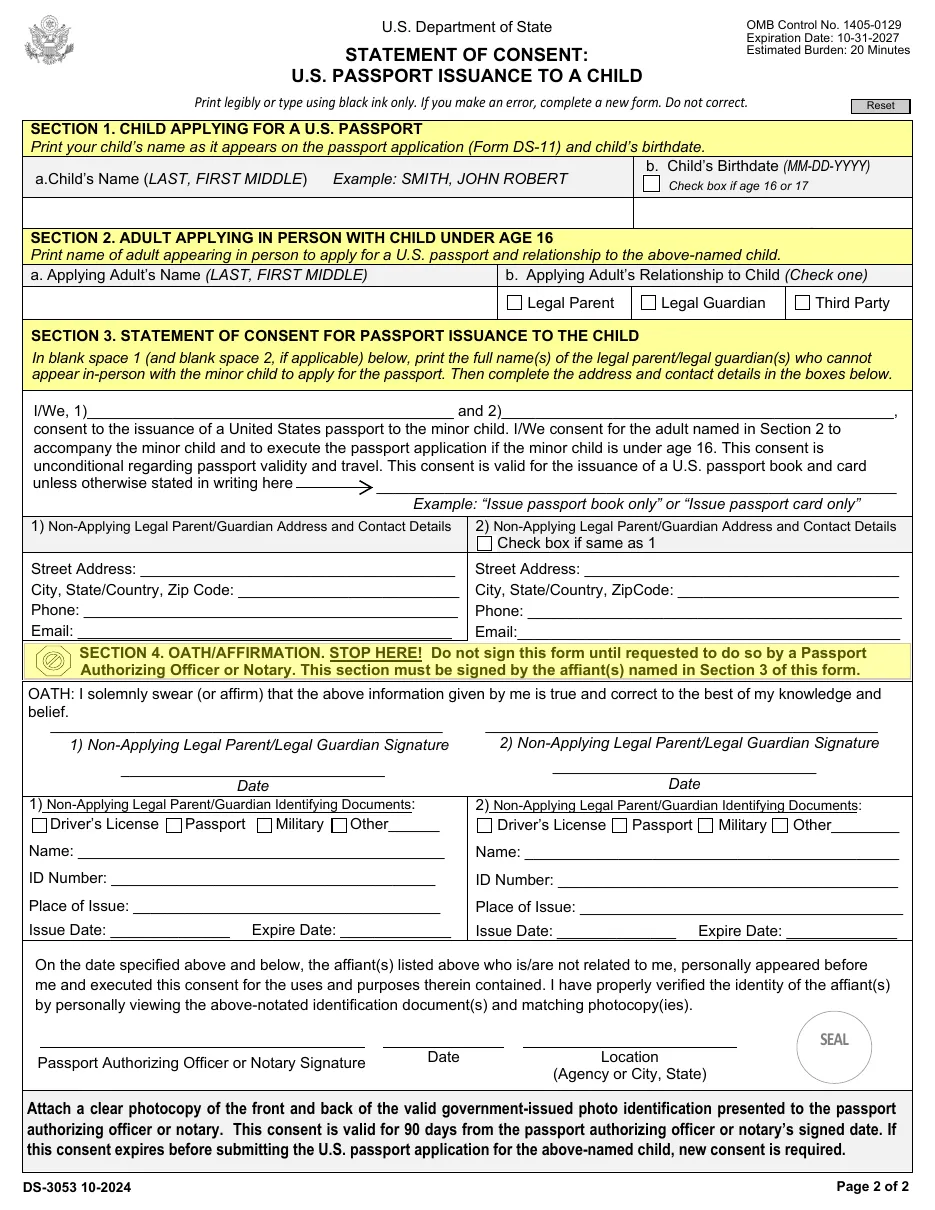
Form DS-3053 is the sworn statement a parent or guardian signs to consent to a child’s U.S. passport when they can’t come to the in-person DS-11 appointment. The parent who can’t attend signs it in front of a notary or passport authorizing officer, and it goes with the child’s DS-11.
Its official name is “Statement of Consent: U.S. Passport Issuance to a Child”. It goes with your child’s Form DS-11, presented in person by the adult applying with the child.
Who files it
Parents or legal guardians who can’t appear in person with their child to apply for a passport.
What you need before you start
- The child’s full name and date of birth, as on the DS-11
- The name of the adult applying in person and their relationship to the child
- Your address, phone number and email
- A valid government-issued photo ID and a photocopy of its front and back
- A notary or passport authorizing officer who is not related to you
Skip the instructions.
Answer a few questions in ChatGPT or Claude. We fill every box of your DS-3053.
How to fill out Form DS-3053, section by section
- Section 1Child applying for a U.S. passportPrint the child’s name exactly as on the DS-11, and the birthdate. Check the box if the child is 16 or 17.
- Section 2Adult applying in personPrint the name of the adult going to the appointment and check legal parent, legal guardian or third party.
- Section 3Statement of consentPrint the full name of each parent or guardian who can’t attend, with their address, phone and email. Write "Issue passport book only" or "Issue passport card only" if you want to limit it.
- Section 4Oath and notaryStop here and sign only when the notary or passport authorizing officer asks. They record your ID details, then sign, date and seal the form.
Government fee
Fees are set by the State Department and can depend on how you file. Check the current fee on the official Form DS-3053 page before you file.
The $4.90 forms. fee is separate. Government fees are always paid directly to the agency.
Where Form DS-3053 goes
Give the signed, notarized form and your ID copy to the adult applying with your child. They present it with the child’s Form DS-11 at the in-person passport appointment.
Common mistakes to avoid
- Signing before you are in front of the notary or passport authorizing officer.
- Using a notary who is related to you.
- Forgetting the photocopy of the front and back of your ID.
- Letting it expire: the child’s application must be submitted within 90 days of the notary’s date.
- Adding conditions on travel or passport validity. The consent must be unconditional.
When the free official option is enough
The State Department publishes a free fillable PDF of the DS-3053 on eforms.state.gov. forms. is for when you'd rather answer questions in plain English and get a checked PDF.
Questions
- Does Form DS-3053 need to be notarized?
- Yes. You sign it under oath in front of a notary or a passport authorizing officer, who must not be related to you. Outside the United States, some countries require a U.S. embassy or consulate instead of a local notary.
- How long is a DS-3053 valid?
- 90 days from the date the notary or passport authorizing officer signs it. If it expires before your child’s application is submitted, you need a new one.
- Do both parents need to be present for a child’s passport?
- For children under 16, yes, unless the parent who can’t attend sends Form DS-3053 or a notarized statement with the same details. A parent with sole authority, for example through a sole custody order, may not need the other parent’s consent.
- Do I need Form DS-3053 for a 16 or 17 year old?
- Not always. For ages 16 and 17, one parent must be aware of the application, and the passport authorizing officer can ask for that parent’s written consent.
- What if the other parent can’t be reached?
- The applying parent may submit Form DS-5525 or a written statement under penalty of perjury explaining why. Check travel.state.gov for what applies to your situation.
- Is this the official form?
- Yes. We fill the Form DS-3053 published by the U.S. Department of State, in its latest edition. You sign it and file it yourself.
- What does the $4.90 cover?
- Filling in the form and downloading the PDF. Government fees, if any, are paid separately to the agency.