IRS Identity Theft Affidavit
Report tax-related identity theft to the IRS. Answer a few questions in ChatGPT or Claude and get the official 14039, filled in and ready to sign.
- For
- Victims of tax-related identity theft, and people filing for a dependent, a deceased person or someone they represent
- Time
- About 10 minutes
- Price
- $4.90, one-time · Government fees not included
You review the filled PDF before you pay. Then you sign it and file it yourself.
4.8 · 129 reviews for this formUpdated November 28, 2026 · Latest edition
 Official PDF · latest edition
What you'll need
- 1Your name, SSN or ITIN, current address and phone
- 2The address on your last filed return, if different
- 3The tax years you think were affected, or “Unknown”
- 4The number of any IRS notice or letter you received about it
- 5If you file for someone else, proof of your authority, such as a court certificate or Form 2848
The guide
Form 14039, explained
Key points
- Use it when someone filed a return with your number, claimed you or your dependent, or used your number to work.
- Online submission is the IRS’s preferred method. Mail and fax also work.
- Don’t file it if an IRS letter already asked you to verify your identity, or if you already filed one for the same incident.
- Identity theft with no tax impact is reported to the FTC at IdentityTheft.gov.
What is Form 14039?
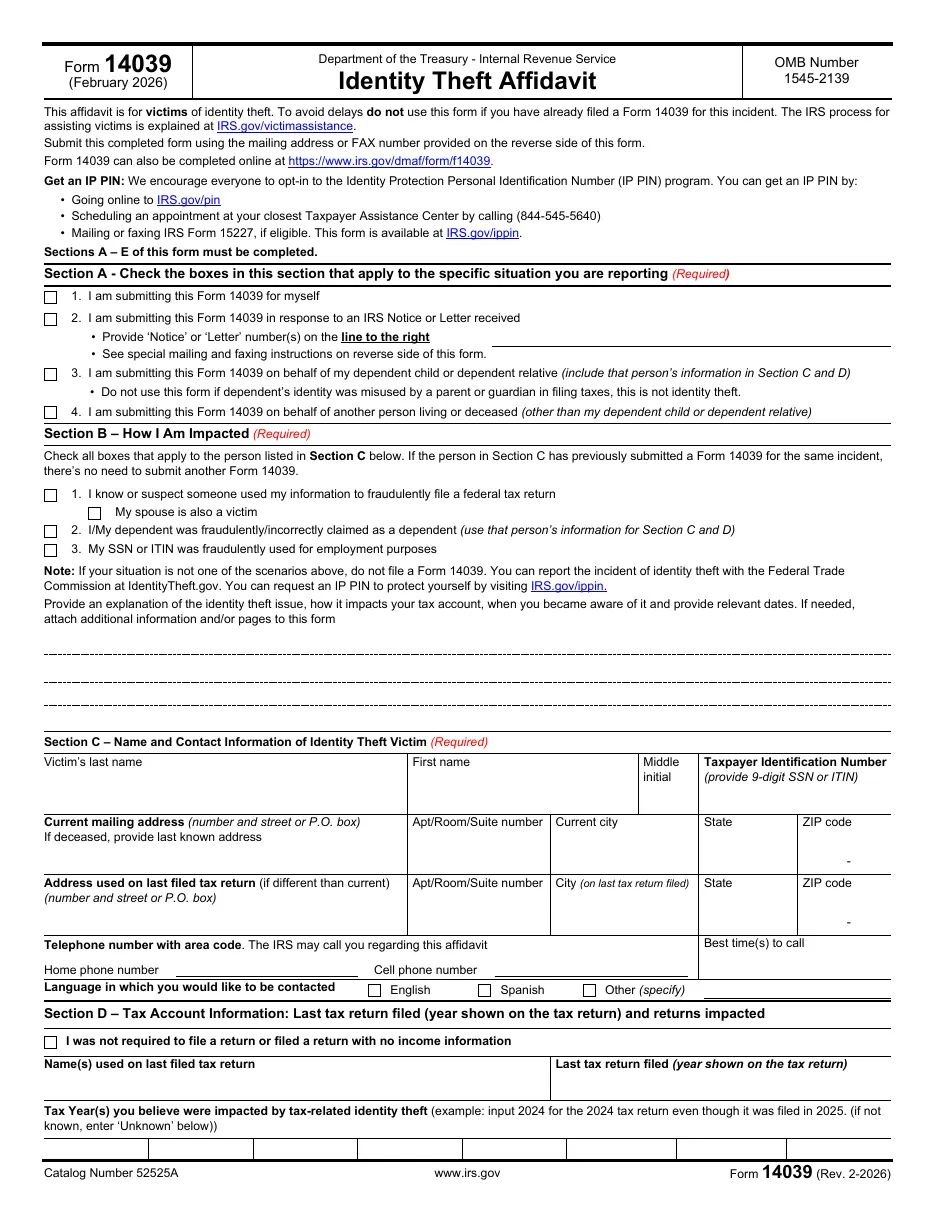
Form 14039 is the IRS affidavit you file when someone used your SSN or ITIN to file a tax return, claimed you or your dependent, or used your number to work. You can submit it online on IRS.gov, which the IRS prefers, or by mail or fax.
Its official name is “Identity Theft Affidavit”. You submit it to the IRS online, by fax or by mail, using only one method.
Who files it
Victims of tax-related identity theft, and people filing for a dependent, a deceased person or someone they represent.
What you need before you start
- Your name, SSN or ITIN, current address and phone
- The address on your last filed return, if different
- The tax years you think were affected, or “Unknown”
- The number of any IRS notice or letter you received about it
- If you file for someone else, proof of your authority, such as a court certificate or Form 2848
Skip the instructions.
Answer a few questions in ChatGPT or Claude. We fill every box of your 14039.
How to fill out Form 14039, section by section
- Section AYour situationWho you are filing for: yourself, in response to an IRS notice (with the notice number), for a dependent, or for another person.
- Section BHow you are affectedA fraudulent return, a dependent wrongly claimed, or your number used for work. Explain what happened and when you found out.
- Section CVictim’s informationName, SSN or ITIN, current address, the address on the last return if different, phone numbers and preferred language.
- Section DTax accountThe year of your last return, the names on it, and the tax years you think were affected.
- Section ESignatureSign and date under penalty of perjury.
- Section FRepresentativeOnly if you file for someone else: your reason and the documents it requires, such as a court certificate, death certificate or Form 2848.
Government fee
Free: the IRS charges no fee to file this form. Source: Form 14039 (Rev. February 2026), which lists no fee.
The $4.90 forms. fee is separate. Government fees are always paid directly to the agency.
Where Form 14039 goes
Online on IRS.gov, or by fax or mail to the number or address on page 2 of the form. If you are answering an IRS notice, use the address or fax number on that notice.
Common mistakes to avoid
- Filing it after an IRS identity verification letter. Follow the letter instead.
- Sending it more than once, or by more than one method. Duplicates cause delays.
- Using it when a parent or guardian claimed a dependent in error. The form says that is not identity theft.
- Leaving Sections A to E incomplete. All five are required.
- Sending your original tax return to the identity theft address or fax number.
When the free official option is enough
The IRS takes Form 14039 online at IRS.gov/dmaf/form/f14039 and calls that the preferred method, though you can’t add attachments online. For identity theft that doesn’t affect your taxes, the form points you to the FTC at IdentityTheft.gov. forms. is for when you'd rather answer questions in plain English and get a checked PDF.
Questions
- How do I report identity theft to the IRS?
- If someone filed a return with your SSN, claimed your dependent or used your number for work, file Form 14039 online, by mail or by fax. Use only one method. If the IRS sent you a letter asking you to verify your identity, follow that letter instead.
- Should I file Form 14039 if I got an IRS letter to verify my identity?
- No. If you got a letter such as 5071C, 4883C or 5747C asking you to verify your identity and return, follow its instructions. The IRS says not to file Form 14039 in that case.
- Can I file Form 14039 online?
- Yes. The IRS has an online version at IRS.gov/dmaf/form/f14039 and calls it the preferred method. Attachments aren’t available online, so use mail or fax if you need to send documents.
- Do I attach Form 14039 to my tax return?
- Only if your SSN or ITIN, your spouse’s or a dependent’s was misused and you can’t e-file because of it. Then attach it to the back of your paper return and mail it where you normally file.
- What else should I do after filing?
- The IRS suggests getting an Identity Protection PIN, following the recovery steps on IdentityTheft.gov, and filing your returns and paying tax as usual. Don’t send a second Form 14039 for the same incident.
- Is this the official form?
- Yes. We fill the Form 14039 published by the Internal Revenue Service, in its latest edition. You sign it and file it yourself.
- What does the $4.90 cover?
- Filling in the form and downloading the PDF. Government fees, if any, are paid separately to the agency.